
A peek behind the curtain: My design process for the Split-Splat Apron
- rubygertz
- Feb 4, 2021
- 4 min read

One of my goals with Spokes & Stitches is to start building up a library of downloadable PDF patterns based on some of my favorite self-drafted designs.
Last year, a ceramicist friend of mine, Erik Wright, came to me with a request for a split-leg apron. He wanted something that would provide a lot of coverage over his legs when he throws on the wheel, and would also be easy to move around in and not too bulky (he often rides his bike to and from his studio).

The design that I came up with has a traditional bib top and partial pant legs that loop behind the calves to hold the garment in place over your clothes. Each pant leg overlaps by a few inches at the waist, and has a generous pleat to provide even more coverage when assuming a wide stance. There are two deep side pockets and one large pocket on the front bib. The apron straps cross in the back and tie at the back waist, to avoid any tension or weight around the back of the neck. A small loop at the waistband is perfect for keeping keys, scissors, or other small tools accessible. The open design in the back allows you to use the bathroom without entirely removing the apron, and you can also easily access your back pants pockets. A second loop is sewn into the seam allowance on the bib facing, so that you can hang the apron on a hook when you are not using it.
In fact, I liked the design so much that I made a version for myself. As someone with a 40E bust, I knew that the apron bib would need to have a dart in order to curve around my upper half and not wing out or gape at the fullest part. I also wanted the apron to nip in a bit at the waist to give it a less “tubular” shape on my body, so I added a second dart at the side seam.


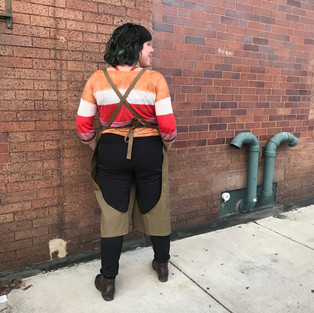


I was so pleased with the final design that I decided this should be the first garment pattern that I digitize and make available for other crafters and sewists to use. I had previously digitized two accessory patterns, but this was my first wearable that needed to be graded to different sizes.
I embarked on a months-long journey of self-education around this topic. As someone who often measures into the top range of other pattern companies’ size charts (despite having statistically “average” measurements), I knew I wanted to cover an inclusive size range. I looked at brands who are setting the bar for inclusive sizing, like Universal Standard and Superfit Hero, for inspiration. I also poured over charts of ASTM measurement data (which I obtained through Pattern Workshop) trying to absorb all I could about how bodies expand as sizes increase. Alvanon also has some great articles, webinars, and resources on this topic.
In the end, I decided to have two separate measurement charts for two different types of proportions; the first being “dynamic” figures like my own that need darts and might otherwise be described as “curvy” or “feminine” (though as someone who is a-little-bit-enby I don’t want to use gendered language if at all possible), and the other for more “linear” bodies like my friend Erik, who have a lower chest-waist-hip ratio.
For those familiar with size charts and pattern grading, I also adjusted my block to account for different rates of growth between sizes A-E, E-J, J-P, and P-U (you can see my "key sizes" highlighted in yellow). Was this a ton of work? Yes! Was it worth it? I hope so. My goal is to offer the best fit possible across a wide range of sizes, because I strongly believe that everyone deserves access to the joy of sewing their own clothes.

At this point I have finished the pattern itself, and am working on putting together the instructions. I am now at the stage of trying to learn all I can about the pattern testing process.
These articles and resources (as well as some conversations with other pattern designers) have proved very useful in giving me, as a new pattern designer, some insight into the process and culture around pattern testing:
As a brand new company without a lot of startup capital (I am not even paying myself yet), I am not quite at a place where I can compensate testers for an hourly rate. However, I have decided that I can and should reimburse testers for the cost of materials and printing the pattern.
If you are excited about this design, would probably want to sew it anyway, and are interested in testing the Split Splat Apron pattern prior to its release, please send me an email, and I can share more details with you about the process and what you can expect.
I am so looking forward to the eventual release of this pattern (hopefully by the end of February or beginning of March). Having put so much time and energy and work into this first one, I am confident that now, with the groundwork in place, I will be able to release future patterns on a faster timeline. I have so many favorite designs that I can’t wait to share with you all.


Comments